

Last Update: September 2026
Written by: Ishita Mehta
Reviewed by: Prem Sharma
Ever opened your offer letter, seen a big number, and then felt confused when a smaller amount landed in your bank account? You’re not alone — this happens because of the difference between gross salary and net salary. Understanding the gross salary meaning is one of the first things you should learn when you start earning, because almost every financial decision — loan eligibility, tax planning, salary negotiation — starts from this one number.
Gross Salary Meaning in One Line
Gross salary is everything you earn from your employer before any mandatory deductions are taken out — think of it as your full paycheck, not your take-home paycheck. It bundles together your basic pay, HRA, DA, any special allowances, and bonuses. What lands in your bank account (your net salary) will always be smaller, since tax (TDS), your PF contribution, and professional tax all get subtracted from this gross figure first.
One thing worth knowing upfront: payroll language isn’t always consistent across companies. Terms like gross salary, gross earnings, taxable salary, CTC, and total compensation get used loosely, and what one employer calls “gross” in an offer letter might not line up exactly with how the Income Tax Act defines salary. This guide sticks to how most Indian employers actually use the term in practice.
What Makes Up Your Gross Salary
Gross salary is usually built from a mix of fixed and variable pieces.
The fixed pieces:
| Component | What it means for you |
|---|---|
| Basic Salary | The anchor of your pay structure — PF, HRA, and gratuity calculations are usually built off this number. There’s no fixed legal ratio, but it’s typically a solid chunk of your CTC. |
| Dearness Allowance (DA) | Mostly relevant if you work in government or PSU roles; it’s meant to cushion you against inflation and is fully taxable. |
| House Rent Allowance (HRA) | Meant for employees paying rent. Whether you get a tax benefit on this depends heavily on which tax regime you’re under. |
| Conveyance/Transport Allowance | Covers your commute. It’s largely taxable now — the old flat ₹1,600/month exemption doesn’t apply across the board anymore. |
| Medical Allowance | A fixed monthly amount for healthcare — fully taxable when paid this way. |
| Special Allowance | A catch-all component; almost always fully taxable. |
The variable pieces: performance bonuses or incentives, Leave Travel Allowance (LTA — the tax break on this is mostly limited to the old tax regime), overtime or shift pay, and perks like a company car or subsidised housing that are taxable depending on how they’re structured.
⚠️ Watch out for the “Special Allowance” trap. A lot of offer letters quietly pad the Special Allowance line to hit your negotiated gross number without touching your Basic Salary. Why it matters: your gratuity, employer PF, and future bonus calculations are often tied to your Basic — though this varies by company policy and applicable scheme rules. So a low Basic plus a fat Special Allowance means a smaller retirement corpus down the line, and a bigger tax bill right now, since Special Allowance is fully taxable. Push for a stronger Basic Salary during negotiations instead of accepting everything as Special Allowance.
What Doesn’t Count as Gross Salary
A few things your employer pays for don’t actually get counted in your gross salary — they’re employer costs or reimbursements instead:
- Gratuity — a separation benefit, generally sitting in your CTC rather than your monthly gross
- Employer’s PF contribution — this is an extra cost the company bears, not something added to your earnings
- Medical reimbursements — bills reimbursed against actual expenses are treated as claims, not fixed salary
- Insurance premiums the company pays on your behalf — a benefit, not cash salary
How to Actually Calculate Gross Salary
The formula is straightforward:
Gross Salary = Basic Salary + HRA + DA + Other Allowances + Bonuses + Taxable Perquisites
Here’s how that plays out for someone with a ₹6 lakh CTC offer:
| Component | Annual Amount (₹) | Type |
|---|---|---|
| Basic Salary | 3,00,000 | Cash |
| HRA | 1,20,000 | Cash |
| Special/Conveyance Allowance | 1,00,000 | Cash |
| Performance Bonus | 30,000 | Variable cash |
| Gross Salary | 5,50,000 | Total cash earnings |
| Employer PF Contribution | 43,200 | Employer cost |
| Gratuity Provision | 6,800 | Employer cost |
| Total CTC | 6,00,000 | Total employer cost |
Notice the gap: ₹5.5 lakh gross vs ₹6 lakh CTC. That extra ₹50,000 goes toward benefits you’ll get later (or never see directly), not cash in your account today.
Gross Salary vs Net Salary
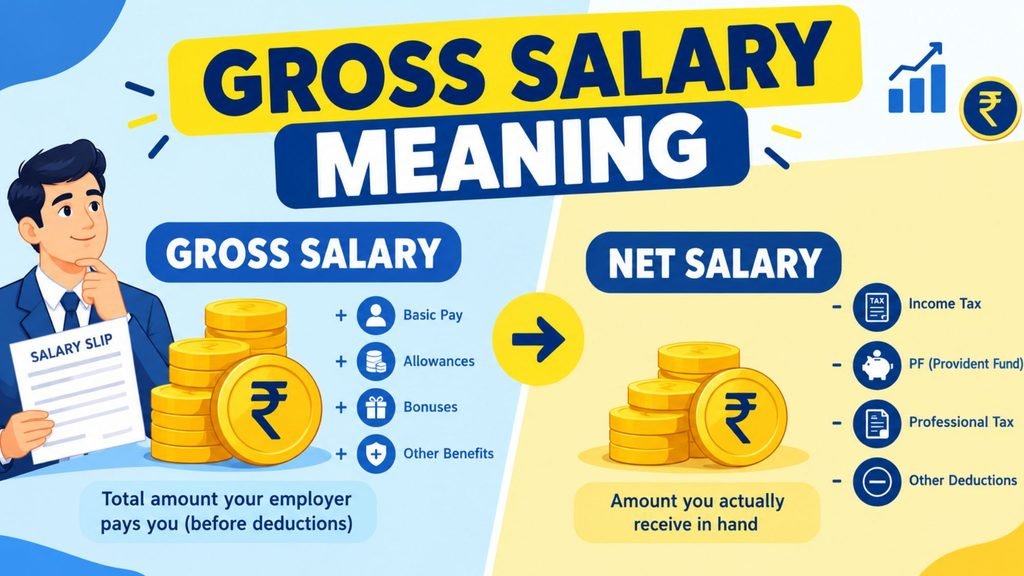
| Gross Salary | Net Salary (In-Hand) | |
|---|---|---|
| What it is | Everything before deductions | What actually hits your account |
| Deductions | None yet | PF, TDS, professional tax, ESI |
| Used for | Loan applications, tax filing | Everyday budgeting |
Sticking with the example above: monthly gross works out to ₹45,833 (₹5,50,000 ÷ 12). After typical deductions, monthly net might land around ₹41,433 — though this is illustrative; your actual number depends on your tax regime, state, and exact structure.
Here’s the part that trips people up: your net salary can change even when your gross salary doesn’t move. Switch your tax regime for FY 2026-27, and your TDS shifts — so your in-hand pay changes, purely because of the tax choice, not because your employer changed anything.
Gross Salary vs CTC
CTC will always sit above gross salary, because it folds in employer-side costs — PF contribution, gratuity, insurance — that never actually reach your bank account as cash. Gross salary is just the “earnings” slice of that bigger CTC number.
Practical rule: if someone offers you ₹10 LPA CTC, don’t do the mental math of ÷12 and assume that’s your monthly take-home. Ask for the full breakup first — your real gross (and net) will be noticeably lower than that headline number.
Is Gross Salary Taxed? (FY 2026-27 Rules)
Yes, though how much tax depends entirely on which regime you pick. The path from gross to tax looks like this: Gross Salary → minus eligible exemptions → Taxable Salary Income → minus Chapter VI-A deductions (only if you’re on the Old Regime) → Total Income (tax applies here).
| Tax/Feature | Old Regime | New Regime (default, Section 115BAC) |
|---|---|---|
| Standard Deduction | ₹50,000 | ₹75,000 |
| HRA exemption | Available, with conditions | Not available |
| 80C/80D-type deductions | Mostly available | Mostly unavailable |
| Tax rates | Higher, but more write-offs | Lower, but fewer write-offs |
The bottom line: a higher standard deduction under the New Regime doesn’t automatically mean it’s the better choice. If you pay significant rent or have sizeable 80C investments, the Old Regime’s HRA and deduction benefits could still work out cheaper for you. Run both through a tax calculator before deciding.
How PF Interacts With Your Gross Salary
Your EPF contribution comes out of your salary, but it isn’t calculated on your whole gross figure — it’s based specifically on your PF wage base, which is Basic + DA + retaining allowance. So it dents your in-hand pay while quietly building your retirement fund in the background.
Monthly Gross vs Annual Gross
- Annual gross is your total cash earnings for the financial year (₹5.5 lakh in our example)
- Monthly gross is that annual figure divided by 12 (₹45,833)
- If your pay includes a bonus paid quarterly or annually, your monthly gross can look steady on paper while your annual gross swings depending on how big that final payout turns out to be
📈 The “paper gross” reality check. Startup, sales, and leadership offers often quote an annual gross that bakes in a big bonus component. Your actual monthly payslip figure will look noticeably smaller for most of the year. Don’t plan your rent or EMIs around annual gross ÷ 12 if a chunk of your pay is variable — budget around your guaranteed monthly gross instead.
Reading Your Gross Salary Off a Payslip
- Find the “Earnings” section — it breaks out Basic, HRA, and every allowance separately.
- Add up everything in that section. That total is your gross salary.
- Many payslips already do this for you and label it “Gross Salary” or “Total Earnings.”
- Deductions (PF, TDS, professional tax) sit in a separate section below — don’t subtract them before you’ve noted the gross number.
How Gross Salary Affects Your Loan Applications
🏦 Banks look at your trend, not just your latest number. Many lenders review your gross salary trend over recent months, though exact criteria — how many months, how much fluctuation is acceptable — vary by lender and loan type. Frequent swings from overtime, shifting allowances, or unpaid leave can make your income look unreliable to an underwriter. Before applying for a home or car loan, keep your last few months’ salary slips clean and steady — avoid unpaid leave or compensation changes right before you apply.
Mistakes People Commonly Make
- Budgeting off gross salary instead of net, then wondering where the money went
- Treating the CTC headline as their actual take-home
- Assuming gross salary is fixed forever, when allowance revisions can change it even with a flat Basic
- Not clarifying whether a quoted “bonus” is part of the monthly gross or a separate annual payout
A Few Things You Can Do Right Now
- Getting an offer? Ask HR for the full breakup — Basic, HRA, allowances, bonus, employer PF, and gratuity — not just the CTC number.
- Negotiating a raise? Push specifically for gross and Basic Salary increases, not just a bigger CTC that hides a flat gross.
- Applying for a loan? Have 3–6 months of stable, clean salary slips ready before you apply.
- Filing taxes? Compare both regimes every year rather than assuming the higher standard deduction wins by default.
Read Also: LPA Full Form / CTC Full Form / Saving vs Investing / Tallyman Axis Bank Meaning
Frequently Asked Questions
Q. Is gross salary the same as basic salary?
No — basic salary is just one piece of gross salary, which also includes allowances and bonuses.
Q. Is PF deducted from gross salary or basic?
It’s deducted from your gross salary, but calculated using your basic wages plus DA, not your entire gross figure.
Q. Why is my in-hand pay so much lower than my CTC?
Because CTC bundles in employer costs (PF, gratuity, insurance) you never see as cash, on top of your own deductions like TDS and PF.
Q. Can I still claim HRA exemption under the New Regime?
No — HRA exemption under Section 10(13A) isn’t available under the default New Regime (Section 115BAC).
Q. Does gross salary matter for a home loan?
Yes, it’s usually the starting reference point, though the final eligible amount depends more on net income and how stable your gross salary trend has been.
Q. Where can I officially check my annual gross salary?
Your Form 16 and your ITR filing both reflect it.
The Real Takeaway
Don’t let a big CTC number distract you when you’re weighing a job offer. Ask for the actual breakup — Basic, HRA, special allowances, expected bonus, and what the employer is putting toward PF and gratuity. Once you know your real gross salary (and can estimate your net), you’re in a much stronger position — both for negotiating and for planning your taxes properly.
Sources
- Tax regime details in this article are based on Income Tax Department rules (incometaxindia.gov.in)
- PF wage base rules follow EPFO guidelines (epfo.gov.in)
- Rates and provisions can change with each Union Budget, so always verify current figures on the official sites before filing your taxes or making financial decisions

Hi, I’m Ishita Mehta, the writer behind The Money Memory. I started this blog to make personal finance simple and stress-free for everyday people. My goal is to break down budgeting, saving, and smart money habits into practical tips anyone can use — no jargon, no complicated formulas. Thanks for stopping by — let’s get better with money, together.