
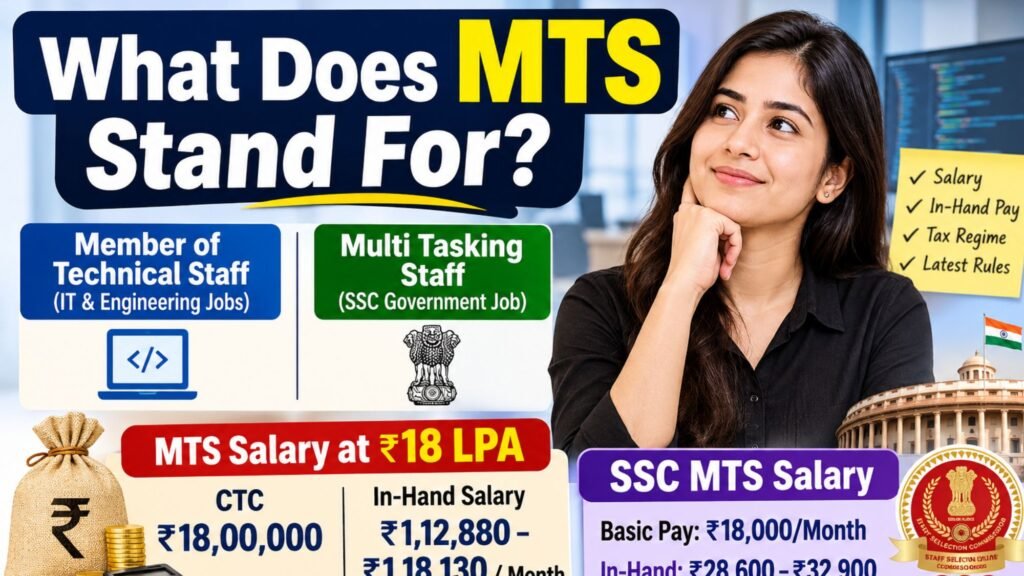
What Does MTS Stand For?
MTS Full Form: The full form of MTS most commonly used in India is “Member of Technical Staff” — a job title used by IT, semiconductor, and core engineering companies for experienced technical employees. The second major meaning is “Multi Tasking Staff,” a government Group C post recruited through the Staff Selection Commission (SSC MTS).
If you’ve landed on this page after seeing an offer letter or job posting, you’re almost certainly looking at the first meaning. A Member of Technical Staff (MTS) in a mid-size Indian tech company typically earns a CTC between ₹10 lakh and ₹30 lakh per year, and the monthly in-hand salary usually falls between ₹75,000 and ₹2,00,000, depending on the company, city, and experience level. The gap between the CTC printed on your offer letter and the amount that actually lands in your bank account is almost never explained clearly — this guide fixes that, with real numbers, step by step.
We’ll cover both meanings of MTS in full detail, including exact salary breakups, tax calculations under both regimes, and the latest 2026 payroll rules.
Other Full Forms of MTS
Before the detailed breakdown, here are the other contexts where MTS appears, so you can confirm which one applies to you:
- Member of Technical Staff — private sector IT/engineering job title (main focus of this article)
- Multi Tasking Staff — SSC government Group C post (covered separately below)
- Medical Transcription Service — a healthcare documentation role
- Mobile TeleSystems (MTS) — a Russian telecom brand, mostly relevant for business/finance news readers
This article focuses primarily on Member of Technical Staff, since that’s the meaning behind most salary-related searches, and includes a complete SSC MTS salary section further below.
Quick Summary Table: MTS (Member of Technical Staff) Salary at ₹18 LPA
This is the most commonly searched CTC range for a mid-level MTS role in cities like Bangalore, Hyderabad, and Pune. All figures below follow 2026 payroll rules, including the labour code requirement that basic pay must be at least 50% of total compensation.
| Component | Amount |
|---|---|
| Annual CTC | ₹18,00,000 |
| Monthly CTC | ₹1,50,000 |
| Monthly Gross Salary | ₹1,37,390 |
| Total Monthly Deductions (New Regime) | ₹19,260 |
| Total Monthly Deductions (Old Regime) | ₹24,510 |
| Monthly In-Hand (New Regime) | ₹1,18,130 |
| Monthly In-Hand (Old Regime) | ₹1,12,880 |
The new regime gives roughly ₹5,250 more in hand every month for this salary level, mainly because it offers a bigger rebate band even though it removes HRA exemption.
CTC vs In-Hand Salary: Why They’re Never the Same
CTC (Cost to Company) is the total yearly expense your employer bears for employing you. It includes your take-home pay plus amounts the company spends on your behalf — employer PF contribution, gratuity provision, and insurance — none of which you receive as cash every month.
In-hand salary (also called take-home salary) is what actually gets credited to your bank account after your own PF contribution, professional tax, and income tax (TDS) are deducted from your gross pay.
This is why a ₹18 lakh CTC offer never translates to ₹1.5 lakh in your account — roughly ₹30,000 to ₹37,000 of that monthly figure gets absorbed by employer-side contributions and deductions before you see it.
Salary Breakdown Table: ₹18 LPA CTC (Metro City, Labour Code Compliant)
| Component | Monthly | Yearly |
|---|---|---|
| Basic Salary (50% of CTC) | ₹75,000 | ₹9,00,000 |
| HRA (50% of Basic, metro) | ₹37,500 | ₹4,50,000 |
| Special Allowance | ₹20,000 | ₹2,40,000 |
| Other Benefits (insurance, LTA, meal card) | ₹4,890 | ₹58,710 |
| Employer PF Contribution | ₹9,000 | ₹1,08,000 |
| Gratuity Provision | ₹3,608 | ₹43,290 |
| Total CTC | ₹1,50,000 | ₹18,00,000 |
Basic salary is now fixed at 50% of CTC because the new labour codes, effective since November 2025, require that basic pay plus dearness allowance together make up at least half of total compensation. This is a direct change from older company structures where basic was often kept at 35–40% to reduce PF and gratuity outgo.
Step-by-Step Calculation: From CTC to In-Hand
Take Rohan, a Member of Technical Staff at a semiconductor company in Bangalore, with a CTC of ₹18,00,000 and 5 years of experience.
Step 1 — Gross Salary
Gross = CTC − Employer PF − Gratuity
Gross = ₹18,00,000 − ₹1,08,000 − ₹43,290 = ₹16,48,710/year (₹1,37,390/month)
Step 2 — Deductions common to both regimes
- Employee PF (12% of basic): ₹9,000/month
- Professional Tax (Karnataka): ₹200/month
Step 3 — Income Tax (calculated separately below for each regime)
Step 4 — Final In-Hand
- New Regime: ₹1,37,390 − ₹9,000 − ₹200 − ₹10,060 (TDS) = ₹1,18,130/month
- Old Regime: ₹1,37,390 − ₹9,000 − ₹200 − ₹15,310 (TDS) = ₹1,12,880/month
So when Rohan checks his bank account on salary day, he sees ₹1,18,130 — not the ₹1,50,000 his offer letter mentioned as monthly CTC.
Deductions Explained — And Why Each One Matters
Employee Provident Fund (PF): 12% of basic salary, matched by the employer. It builds a retirement corpus that earns a fixed, government-declared interest rate and is tax-free on withdrawal after 5 years of continuous service. Skipping this reduces your take-home today but weakens your retirement safety net.
Professional Tax: A small state government tax, usually ₹200/month, capped at ₹2,500/year under the Constitution. Some states, including Delhi and Haryana, don’t charge it at all. It funds local civic and welfare schemes.
Income Tax (TDS): Deducted monthly based on your projected annual income and regime choice. It funds public infrastructure, defence, and welfare spending, and is adjusted at year-end based on actual investment proofs submitted.
Gratuity: Not deducted from your salary — it’s a company-funded benefit that becomes payable once you complete 5 years of continuous service, calculated as (Basic × 15/26) per year of service. It rewards long-term employment and is tax-free up to ₹20 lakh.
Group Insurance Premium: Many companies deduct a small amount for enhanced health or term insurance cover. It matters because the base company-provided cover is often insufficient for a family.
Income Tax on This Salary: New vs Old Regime
| Particulars | New Regime (FY 2025–26) | Old Regime |
|---|---|---|
| Gross Salary | ₹16,48,710 | ₹16,48,710 |
| Standard Deduction | ₹75,000 | ₹50,000 |
| HRA Exemption | Not allowed | ₹2,10,000 (rent ₹25,000/month assumed) |
| Section 80C | Not allowed | ₹1,50,000 |
| Section 80D | Not allowed | ₹25,000 |
| Taxable Income | ₹15,73,710 | ₹12,13,710 |
| Tax Before Cess | ₹1,16,057 | ₹1,76,613 |
| Health & Education Cess (4%) | ₹4,643 | ₹7,065 |
| Total Tax Payable | ₹1,20,700 | ₹1,83,680 |
| Monthly TDS | ₹10,060 | ₹15,310 |
New regime wins here, saving Rohan about ₹62,980 a year, because the rebate and slab structure under the new regime (rebate up to ₹12 lakh taxable income) now benefits most salaried employees even without claiming deductions.
The old regime only becomes better if you have a home loan with significant interest deduction, high HRA exemption, and maximise 80C and 80D fully. If you don’t have a home loan or high rent, the new regime almost always comes out ahead at this income level.
In-Hand Salary Variations
By Experience Level
| Level | Typical CTC | Approx. Monthly In-Hand |
|---|---|---|
| Junior MTS (2–4 yrs) | ₹10–14 LPA | ₹72,000–95,000 |
| Mid-level MTS (4–7 yrs) | ₹16–22 LPA | ₹1,05,000–1,40,000 |
| Senior/Staff MTS (8+ yrs) | ₹28–40 LPA | ₹1,70,000–2,30,000 |
These are approximate ranges and vary by company, city, and how CTC is structured.
By City Type (₹18 LPA, Metro vs Non-Metro)
| Factor | Metro (Bangalore/Hyderabad) | Non-Metro (Jaipur/Indore) |
|---|---|---|
| HRA (% of Basic) | 50% | 40% |
| Monthly HRA | ₹37,500 | ₹30,000 |
| Old Regime Tax Advantage | Higher HRA exemption | Lower HRA exemption |
| Approx. Monthly In-Hand | ₹1,18,130 (new) | ₹1,16,500–1,19,500 (new) |
Under the new regime, city type barely affects your in-hand pay since HRA exemption isn’t available anyway. Under the old regime, metro employees save more tax because of the higher HRA exemption limit.
SSC MTS (Multi Tasking Staff) Salary — Government Role
If you’re searching for the government meaning, here’s the complete picture.
SSC MTS is a Group C, non-gazetted post under Pay Level 1 of the 7th Pay Commission matrix, with a starting basic pay of ₹18,000/month. Eligibility requires passing Class 10, with age limits of 18–25 years for most posts (relaxable for reserved categories).
| Component | X Category City | Y Category City | Z Category City |
|---|---|---|---|
| Basic Pay | ₹18,000 | ₹18,000 | ₹18,000 |
| Dearness Allowance (approx. 58%) | ₹10,440 | ₹10,440 | ₹10,440 |
| HRA (30%/20%/10% of basic) | ₹5,400 | ₹3,600 | ₹1,800 |
| Transport Allowance + DA | ₹2,133 | ₹1,422 | ₹1,422 |
| Gross Monthly Salary | ₹35,973 | ₹33,462 | ₹31,662 |
| NPS Employee Deduction (10% of Basic+DA) | ₹2,844 | ₹2,844 | ₹2,844 |
| Approx. In-Hand Salary | ₹32,900 | ₹30,400 | ₹28,600 |
Government MTS staff are covered under the National Pension System, not EPF, so retirement contributions are deducted as NPS, not PF. Income tax is usually zero at this salary level, under both regimes, because taxable income stays well below the rebate threshold.
Priya, an MTS posted in a Y-category city, sees ₹30,400 credited to her account every month — her payslip shows no income tax line because her annual income doesn’t cross the taxable threshold after standard deduction.
Dearness Allowance is revised twice a year (January and July) and the exact current rate should always be checked against the latest government circular, since it directly changes gross pay.
How to Increase Your In-Hand Salary — Legally
- Ask for employer NPS contribution under Section 80CCD(2): This is deductible even under the new tax regime, up to 10% of basic for private employees. It reduces taxable income without touching your CTC.
- Maximise tax-free reimbursements: Telephone, internet, and books/periodicals allowances, if offered, reduce taxable salary.
- Choose the regime that fits your deductions: Run both calculations every year before the deadline — don’t assume the same regime suits you every year.
- Negotiate the CTC split, not just the number: A higher base/special allowance split (within the 50% basic rule) can sometimes increase monthly liquidity.
- Avoid over-investing in low-return tax-saving instruments just for 80C: Under the new regime, this deduction doesn’t apply, so don’t lock money unnecessarily.
Common Mistakes People Make While Reading Offer Letters
- Confusing monthly CTC with monthly in-hand pay — they can differ by 20–25%.
- Not checking if PF and gratuity are included inside the CTC figure — most companies include them, inflating the headline number.
- Assuming variable pay or bonus is guaranteed — it’s usually performance-linked and not paid in full automatically.
- Missing the basic salary percentage — a lower basic means lower PF and gratuity accumulation over time.
- Not verifying which tax regime the company applies by default — the new regime is the default since FY 2023–24; you must actively opt for the old regime if it suits you better.
- Ignoring one-time components — joining bonus or relocation allowance shown in year one inflates that year’s CTC but won’t repeat.
Latest 2026 Updates Affecting MTS Salary
- New Labour Codes (effective November 2025): Basic pay plus DA must now be at least 50% of total CTC for all employees. This has increased PF and gratuity contributions industry-wide compared to older salary structures.
- New Tax Regime Slabs (Budget 2025, applicable FY 2025–26): Rebate under Section 87A now makes income up to ₹12 lakh tax-free (around ₹12.75 lakh for salaried employees after standard deduction).
- Standard Deduction: ₹75,000 under the new regime, ₹50,000 under the old regime.
- EPF Wage Ceiling: Still ₹15,000/month for mandatory coverage; this figure hasn’t changed in recent years, though many companies voluntarily contribute on actual basic above this ceiling.
- 8th Pay Commission: Approved in principle for central government employees, including MTS (government) staff, but implementation timelines are not yet finalised — treat this as upcoming, not current.
- Gratuity under the Social Security Code: Fixed-term contract employees now get proportionate gratuity without needing to complete 5 years, though permanent employees still need 5 years of continuous service.
These rules should be confirmed against your specific company’s HR policy and your state’s professional tax rules, since implementation detail varies.
Read Also: LPA Full Form / Saving vs Investing / Tallyman Axis Bank Meaning / 3 LPA Means How Much Per Month?
FAQs
1. What is the full form of MTS?
MTS most commonly stands for “Member of Technical Staff,” a private-sector IT and engineering job title. It can also mean “Multi Tasking Staff,” a government post recruited through SSC. The correct meaning depends on the context — job offer letters almost always mean the former.
2. What is the in-hand salary for an 18 LPA CTC as MTS?
For a metro-based Member of Technical Staff with ₹18 LPA CTC, monthly in-hand pay is approximately ₹1,18,130 under the new tax regime and ₹1,12,880 under the old regime, after PF, professional tax, and income tax deductions.
3. Which tax regime is better for MTS salary?
For most MTS employees without a home loan, the new regime results in lower tax and higher in-hand pay. The old regime only wins if you claim significant deductions like home loan interest, high HRA, and full 80C and 80D limits.
4. What is the salary of SSC MTS?
SSC MTS starts at a basic pay of ₹18,000/month under Pay Level 1, with gross salary between ₹31,600 and ₹36,000 depending on posting city, and in-hand pay roughly ₹28,600 to ₹32,900 after NPS deduction.
5. Does an MTS employee get PF and gratuity?
Private-sector MTS employees get both EPF and gratuity (after 5 years of continuous service). Government MTS staff are covered under NPS instead of EPF, with gratuity rules under the central government pension framework.
Conclusion
The MTS full form depends entirely on context — “Member of Technical Staff” for most private-sector job offers, and “Multi Tasking Staff” for SSC government recruitment. For a typical ₹18 LPA MTS package in a metro city, expect a monthly in-hand salary between ₹1,12,000 and ₹1,18,000 depending on your tax regime, while SSC MTS staff typically take home ₹28,600 to ₹32,900 a month depending on their posting city. Always separate CTC from in-hand pay, check your basic salary percentage, and compare both tax regimes every year before deciding — that single step alone can add thousands of rupees to your annual take-home pay.

Hi, I’m Ishita Mehta, the writer behind The Money Memory. I started this blog to make personal finance simple and stress-free for everyday people. My goal is to break down budgeting, saving, and smart money habits into practical tips anyone can use — no jargon, no complicated formulas. Thanks for stopping by — let’s get better with money, together.